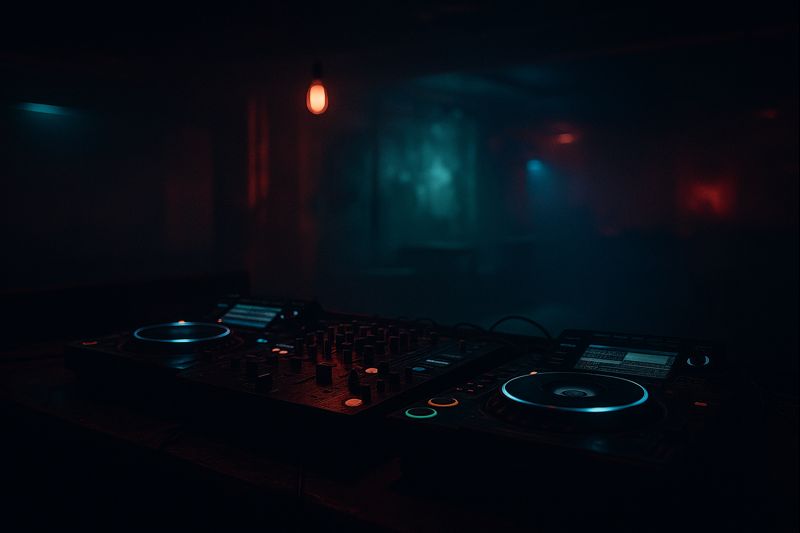
I've been DJing for 15 years. I started on a cheap controller in Dubai mixing hip-hop, trying not to panic every time a verse ended sooner than I expected. I'm Slovak, but I grew up in the UAE, so my early DJ world was this strange mix of expat nightlife and commercial expectations. Later I worked multi-genre club nights, toured Europe with 90s eurodance acts, played underground techno sets and commercial sets in different cities.
I'm not claiming other places are better. Dubai wasn't better. A lot of European cities aren't better. The music industry everywhere has its own version of this problem—venue owners squeezing artists, DJs undercutting each other, the same race to the bottom.
But I'm in Bucharest right now. And I'm watching what's happening here.
Something broke in this city between late 2023 and early 2024. The scene wasn't perfect before, but there was at least some baseline respect. Now? It's gone. What used to be difficult became impossible. Venue owners stopped pretending to value DJs. The standard became: pay nothing, or pay as close to nothing as possible.
And here's the contradiction: these same venues will throw money at a big-name DJ. Or at least they'll act like they can. Some of them genuinely don't have the budget and will whine for discounts, trying to negotiate down a known artist's fee like they're buying vegetables at the market. But they'll try. They'll find money somewhere when it's someone with name recognition.
A local DJ with 15 years of experience who can actually read a room and build a night? That's worth €50. Or drinks. Or "exposure."
The logic doesn't track as a business decision, but here we are.
Venue Owners Who've Figured Out They Can Just Not Pay
The conversation happens the same way every time now.
You reach out about a gig. They check your background—years of experience, international work, solid technical skills. They like your sound. They're interested.
Then: "What's your rate?"
"We don't have a budget for DJs right now, but it's great exposure."
"We can pay you in drinks and food."
"If the night goes well, maybe we can discuss something for next time."
Or the one that really does it: "We're paying €50 for a four-hour set."
Here's what these venues actually have:
Full staff on monthly salaries. Bartenders making €800-1200. Security getting paid. Managers getting paid. Everyone has a contract.
They're charging €7 for a beer. €15-20 for cocktails. On a decent Friday or Saturday they're pulling €3,000-5,000.
They have lighting. They have sound systems, though half of them expect you to bring your own controller because apparently investing in a proper DJ setup is too much. Most of them never had their own equipment to begin with, and now they want you to work for free on top of bringing your own gear.
But the person responsible for keeping people in that space, for reading the room and adjusting energy, for making the night actually work—that's optional.
"Pay you in food and drinks"? Motherfucker, that doesn't pay my rent. It doesn't cover transport. It doesn't acknowledge the years spent learning this, building a library, investing in equipment, developing an ear for what works.
They pay their bartender in money because they understand that person needs to survive. A DJ is somehow different.
And when the night works—when the place is full, when people are drinking, when it's objectively successful—there's always a new reason. "Revenue wasn't what we expected." "We had some unexpected costs." "The owner changed his mind."
Translation: we got what we needed from you, and now we're not paying.
This level of disrespect is new. Maybe it was never ideal, but this became the standard in 2023-2024. Bucharest specifically decided DJs have zero value.
Booking Agencies and The "Who You Know" Problem
Then there's the booking agency angle that makes this entire mess even worse.
Agency owners are friends with venue owners. They're friends with concert organizers. They're connected to festival promoters. That's how the business works, and that's fine—networking matters.
Until you realize some dweeb who can't beatmatch two tracks at the same BPM is opening for a superstar performer because his agency has the right connections.
Merit doesn't factor into it. Skill doesn't matter. Whether you can actually DJ becomes irrelevant when the booking agent and the venue owner went to university together or drink at the same bar.
I've seen DJs who've been playing for six months get slots at major events because their agency pushed them. I've seen technically incompetent DJs open for international acts because someone knew someone. The crowd doesn't get quality. The headliner has to follow a trainwreck warmup set. The entire event suffers.
But the agency gets their commission. The venue owner gets to book their friend's client. Everyone in the circle wins except the audience and the DJs who actually deserve the slot based on ability.
And nobody says anything because everyone's trying to get in on that same nepotistic circle. Everyone thinks "maybe if I'm nice enough, maybe if I don't make waves, I'll be the one getting pushed next time."
You want to talk about equipment disasters? SAGA Festival 2024. Hardwell—an internationally known DJ, someone who's played massive stages worldwide—walks off after 10 minutes. Equipment failing. Claims the festival didn't pay him. The whole booth was shit, nothing worked.
The festival organizers pushed back, said the equipment was fine, other DJs used it without problems. Doesn't matter who was right. The point is this: if a major festival with international headliners can't get their technical setup sorted, what the fuck are small venues doing? And if even big-name DJs are dealing with payment issues and equipment failures, what chance do local DJs have?
The entire system is degraded. Merit is dead. It's about who you know, who knows you, and whether your agency has enough pull to get you in the door regardless of whether you can actually perform.
Everyone says "that's just how it is" because they've given up. And that acceptance makes the whole thing worse.
The DJs Who Enable This Bullshit
But venue owners and booking agencies wouldn't get away with this if DJs didn't let them.
Every DJ who accepts an unpaid gig makes it harder for everyone else. Every DJ who plays for €50 and convinces themselves it's "networking" or "building a following" is participating in their own exploitation and lowering the bar for the rest of us.
The psychology is predictable. You want to play. You want to be part of the scene. You think if you prove yourself, if you just get in front of people, something will open up. Some opportunity.
What actually happens: you become the new standard. Venues now know they can find someone who will play for nothing. Why would they ever pay again?
The scene here has become completely cannibalistic. No solidarity. No one helps anyone. Everyone's competition.
The old heads are scared of being pushed out, so they guard whatever little territory they have. They don't mentor. They don't share knowledge. They just try to hold onto their scraps.
The young DJs are desperate to prove something—to themselves, to their friends, to Instagram. So they take anything. Any gig, any conditions, any chance to post a story from a booth, even if it's for free in an empty room.
The in-between generation, the ones who should know better? Attitude problems without the skills to back it up. Thinking they've made it because they played some mid-tier venue once or got a few hundred likes on a mix.
No one has anyone's back. No one says "this is unacceptable, we deserve better." Everyone's too busy trying to claw their way up.
Everyone's weak, taking whatever they're offered and hoping it leads somewhere. Maybe I'm fucking up too somehow. But at least I can see the pattern.
Influencers Who Mistake Followers For Skill
Then there's the influencer DJ problem, which deserves its own section because it's genuinely absurd.
Someone has 50k Instagram followers from posting fitness content, lifestyle shots, club photos. They decide DJing looks good for their brand. They buy a controller, watch a few YouTube tutorials, and suddenly they're booking gigs.
Their music selection is terrible. Their mixing is embarrassing—trainwrecks, awkward transitions, zero sense of flow. They can't read a room. They don't understand how to build energy or create an actual experience.
But they have followers. Or they claim to.
Let's be clear about those follower counts: 80-90% are probably fake. Bought bots. Dead accounts. Engagement farms. The marketing agencies booking these people should know this, but they're probably friends with the influencers anyway, so nobody checks. Nobody verifies that those 50k followers translate to actual attendance or spending.
If I had a dollar for every influencer-turned-DJ who couldn't get 200 people to actually show up to a venue, I'd have a lot of dollars. "Followers"—sure. Followers who don't go anywhere, don't spend money, don't engage beyond double-tapping a photo.
But venue owners book them anyway. Sometimes they even pay them, because they think the influencer will bring a crowd.
What happens: the influencer posts about the gig. Maybe 200 of their "followers" show up. They take photos. They post stories. They stand around barely drinking because they're there for content, not music. They're not spending at the bar. They're not there to party. They're there to be seen.
The music is bad. Anyone who came for actual music leaves. The vibe dies.
But the venue owner sees 200 people and thinks it worked.
Here's what they're missing: 50 people who actually care about music are worth more than 200 Instagram props. Those 50 will stay all night. They'll drink. They'll come back. They'll tell people "that place has incredible music." That builds something real.
Book the influencer with no skills. Let them play their Spotify-curated playlist with no mixing ability. Kill the room. Wonder why nothing sticks.
These useless fucks are just there to be seen. And venues keep rewarding them for it.
The People Who Want "Underground" But Won't Support It
Everyone in this city complains about the lack of underground venues. No places with real music. No rooms for proper techno, house, breakbeat, actual electronic music that isn't commercial garbage.
Then someone creates an underground event. A DJ plays real music—deep selections, proper tracks, something that challenges people instead of pandering to the lowest common denominator.
The room is empty.
Or people show up, stand like dead fish for 30 minutes, and leave because they don't recognize anything and it's not giving them the Instagram moment they wanted.
These are the same people who were just complaining about how commercial everything is. How Bucharest has no culture. How everything's mainstream now.
But when you give them the alternative, they don't show up. Maybe it's a marketing problem. Maybe underground events don't have the budget to promote properly and people genuinely don't know they exist.
Or maybe most people don't actually want underground music. They want the aesthetic of being alternative without doing any work to support it. They want to complain about the scene without participating in building something better.
Who knows. Either way, the events don't get support, and the cycle continues.
What This Is Doing
This isn't sustainable. You can't build a music scene on exploitation and delusion.
Skilled DJs—people who've spent years developing their craft, who understand music theory, who can actually mix, who know how to work a room—are leaving. Or they're playing less. Or they're just getting bitter and jaded because why the fuck would you keep doing this when you're not valued?
The DJs who stay are either desperate, delusional, or have another income source that allows them to treat this as a hobby.
Meanwhile venues cycle through whoever will accept their garbage terms, the quality gets worse, crowds get bored, and everyone wonders why the nightlife scene is trash.
Influencers keep getting booked because they bring numbers, even if those numbers mean nothing for the venue's actual bottom line or culture.
The venues that actually pay—there are a few—get overwhelmed with requests because every decent DJ in the city is trying to get one of the rare spots that treats them like a professional.
And nobody's talking about it honestly. Everyone's too scared of burning bridges or looking difficult or not being "grateful for the opportunity."
Where This Goes
I don't know if this is fixable. The data doesn't suggest it is. There's no solidarity among DJs to collectively refuse unpaid gigs. Venue owners have no financial incentive to change when they can exploit desperate talent. Booking agencies will keep pushing their connected clients regardless of merit.
What I know: the current system is killing the scene. It's killing the culture. It's rewarding the wrong things and pushing out the people who actually care about music.
Maybe other cities figured this out already. Maybe Bucharest will eventually. Maybe it won't.
But right now, watching DJs accept scraps, venues act like paying for music is optional, influencers get rewarded for mediocrity, and booking agencies prioritize connections over competence—there's no logical path to improvement.
Everyone can go fuck themselves.